Car Transport from Germany — How Much Does It Cost and How to Order?
Car Transport from Germany — How Much Does It Cost and How to Order?
Germany remains the largest source of used car imports for buyers across Central and Eastern Europe, especially Poland. With over 800,000 vehicles imported from Germany in 2025 alone, the demand for reliable cross-border car transport keeps growing in 2026. Whether you've bought a bargain BMW in Munich or a family van in Berlin, getting it safely home is the next step — and we make that trip several times a week.
Here's what it costs, what methods are available, which documents you need, and how to order the service.
Why Buy a Car in Germany?
Competitive Pricing
Germany is Europe's largest automotive market. High supply means competitive prices — the same models often cost 15–30% less than equivalents in Poland, the Czech Republic or other neighbouring countries. Premium brands like BMW, Mercedes and Audi depreciate faster in Germany, creating exceptional value for import buyers.
Massive Selection
Portals like mobile.de and autoscout24.de list millions of vehicles. You can filter by mileage, service history, equipment level and more, giving you far more choice than any local market.
Better Technical Condition
Germany's strict TUV inspection regime means cars that fail technical standards are taken off the road. As a result, German-market vehicles tend to be well-maintained, with thorough service documentation and genuine mileage records.
Methods of Car Transport from Germany
1. Flatbed Tow Truck (Laweta)
A flatbed tow truck is the safest method of vehicle transport. The car is loaded onto a hydraulic platform and secured with professional straps — no extra mileage, no wear on the drivetrain, no risk of road damage. We recommend this for:
- Vehicles that aren't roadworthy or lack valid inspection
- Luxury, sports or classic cars
- Cars without valid insurance or registration plates
- Accident-damaged vehicles
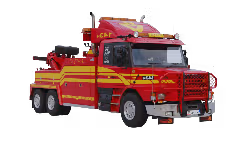
A professional flatbed truck comes equipped with a hydraulic ramp, winch and securing straps, guaranteeing safe transport on any route.
2. Multi-Car Transporter
A multi-car transporter carries 5–9 vehicles simultaneously on a purpose-built trailer. It's the cheapest option per vehicle, but delivery times are longer — the carrier needs a full load. Expect 3–14 days. This suits buyers who aren't in a rush and want to minimise costs.
3. Self-Driving (Uberfuhrung)
Driving the purchased car from Germany yourself seems cheapest at first glance, but hidden costs add up fast:
- Fuel for 400–800 km
- Short-term German insurance (Kurzzeitversicherung)
- Temporary plates (Kurzzeitkennzeichen) and administrative fees
- Motorway tolls and vignettes
- Extra mileage on the odometer, reducing the car's resale value
- Risk of breakdown on the road
How Much Does Car Transport from Germany Cost in 2026?
Transport costs depend on distance, method, vehicle size and scheduling urgency. Below are indicative price ranges for 2026.
Individual Flatbed Transport
| Route | Distance | Approximate Cost |
|---|---|---|
| Berlin — Warsaw | ~580 km | PLN 1,800 – 2,800 (EUR 420 – 650) |
| Berlin — Poznan | ~270 km | PLN 1,200 – 1,900 (EUR 280 – 440) |
| Munich — Krakow | ~800 km | PLN 2,500 – 3,800 (EUR 580 – 880) |
| Frankfurt — Wroclaw | ~630 km | PLN 2,000 – 3,000 (EUR 465 – 700) |
| Hamburg — Gdansk | ~680 km | PLN 2,200 – 3,200 (EUR 510 – 740) |
Multi-Car Transporter
| Route | Approximate Cost |
|---|---|
| Berlin — Warsaw | PLN 900 – 1,500 (EUR 210 – 350) |
| Munich — Krakow | PLN 1,200 – 2,000 (EUR 280 – 465) |
| Frankfurt — Wroclaw | PLN 1,000 – 1,700 (EUR 230 – 395) |
Self-Driving Total Cost
| Component | Cost |
|---|---|
| Fuel (600 km, 7 l/100 km) | PLN 350 – 500 |
| Temporary plates (Kurzzeitkennzeichen) | PLN 250 – 400 |
| Short-term insurance | PLN 300 – 600 |
| Tolls / vignettes | PLN 50 – 150 |
| Total | PLN 950 – 1,650 |
Check our up-to-date rates on the price list.
How to Order Car Transport — Step by Step
Step 1: Get a Quote
Contact the transport company with details: pick-up and delivery addresses, vehicle make, model and condition (running / non-running), and your preferred date. The fastest way is through our free quote form or by phone.
Step 2: Confirm the Schedule
Once you accept the quote, agree on an exact pick-up window and delivery address. A professional company gives you a specific time slot (e.g. "Tuesday 14:00–16:00").
Step 3: Prepare Documents
Make sure you have the full set of documents (detailed below). Without them, transport or later registration may be delayed.
Step 4: Vehicle Pick-Up in Germany
The flatbed driver collects the car at the agreed German address. A condition report is prepared — take photos documenting the vehicle's state before loading.
Step 5: Delivery and Payment
The car is delivered to your address in Poland. On receipt, inspect the vehicle and sign the delivery report. Payment is typically cash on delivery or bank transfer in advance.
Required Documents
- Kaufvertrag — the purchase contract, showing both parties, vehicle identification (VIN), price and date.
- Fahrzeugbrief (Zulassungsbescheinigung Teil II) — the German vehicle title proving ownership. You can't register the car in Poland without the original.
- Zulassungsbescheinigung Teil I — the German registration certificate. If the car has been de-registered (abgemeldet), you'll receive a stamped confirmation.
- Short-term insurance & temporary plates — only needed if driving the car yourself. Not required for flatbed transport.
Tip: Choosing flatbed transport means you can skip temporary plates and short-term insurance, saving EUR 130–230.
Popular Routes
| Route | Distance | Flatbed Time |
|---|---|---|
| Berlin — Warsaw | ~580 km | 6–7 h |
| Munich — Krakow | ~800 km | 9–10 h |
| Frankfurt — Wroclaw | ~630 km | 7–8 h |
| Hamburg — Gdansk | ~680 km | 7–9 h |
| Stuttgart — Katowice | ~750 km | 8–9 h |
What to Look for When Choosing a Transport Company
- Cargo insurance — The company must hold carrier liability insurance (OCP) covering at least the vehicle's value. Ask for proof of the policy.
- Experience with international transport — Choose a company that specialises in cross-border vehicle transport and knows customs procedures.
- Reviews and references — Check Google Maps, Facebook and automotive forums for detailed reviews of international transports, not just local towing.
- Transparent pricing — Avoid companies quoting "from..." without a firm total. A professional quote includes pick-up, loading, transport and unloading with no hidden surcharges.
- Modern fleet — Make sure the company uses modern flatbed trucks with hydraulic platforms, winches and securing equipment.
Registering an Imported Car in Poland
After bringing the car to Poland, you have 30 days to complete registration. Here's the process:
- Excise duty — 3.1% of value for engines up to 2.0 L, or 18.6% for larger engines. Electric and plug-in hybrid vehicles pay 1.55%.
- Sworn translation of Kaufvertrag, Brief and other German documents (PLN 50–150 per document).
- Technical inspection at a Polish vehicle inspection station (PLN 99–162).
- Mandatory third-party insurance (OC).
- Registration at the local vehicle registration office with all documents (approx. PLN 256 with new plates).
Flatbed vs Self-Driving: Cost Comparison
| Criterion | Flatbed | Self-Driving |
|---|---|---|
| Vehicle safety | Maximum — zero risk | Risk of breakdown / accident |
| Extra mileage | 0 km | 400–800 km |
| Temporary plates & insurance | Not needed | PLN 550–1,000 |
| Fuel | Included | PLN 350–500 |
| Tolls | Included | PLN 50–150 |
| Time | 6–10 h door-to-door | 5–9 h + admin |
| Stress | Minimal | High |
| Total cost (~600 km) | PLN 1,800 – 2,800 | PLN 950 – 1,650 |
When you factor in extra mileage reducing the car's value by PLN 200–500, the risk of breakdown, and the stress of driving in a foreign country, flatbed transport is the better choice in most cases — especially for vehicles worth over PLN 30,000.
Frequently Asked Questions (FAQ)
1. How long does flatbed transport from Germany take?
Flatbed transport typically takes 6 to 12 hours depending on the route. Berlin to Warsaw is about 6–7 hours; Munich to Krakow around 9–10 hours. We usually fulfil orders within 1–3 days of booking.
2. Can you transport a car that doesn't run?
Yes — that's one of the key advantages of flatbed transport. Our trucks have winches, so we can load non-running vehicles, cars without batteries, accident-damaged vehicles and even those with locked wheels.
3. Is the car insured during transport?
Yes. Professional transport companies carry carrier liability insurance (OCP) that protects the cargo throughout the journey. Always ask for proof of the policy and its coverage amount before placing an order.
4. What documents do I need when picking up a car in Germany?
You need: Kaufvertrag (purchase contract), Fahrzeugbrief (vehicle title), Zulassungsbescheinigung Teil I (registration certificate) and your ID or passport. If the car travels on a flatbed, temporary plates and short-term insurance aren't required.
5. What's the total cost of importing and registering a car from Germany?
The total includes: transport (PLN 1,800–3,500 by flatbed), excise duty (3.1–18.6% of value), sworn translations (PLN 100–300), technical inspection (PLN 99–162), insurance (PLN 500–2,000/year) and registration (~PLN 256). For a car worth PLN 40,000 with a 2.0 L engine, the total additional cost is approximately PLN 4,500–7,000.
Need to transport a car from Germany? Call us at +48 571 426 225 or request a free online quote. We transport vehicles from anywhere in Germany to any location in Poland, 7 days a week.
Potrebujete cestnú asistenciu?
Zavolajte odťahovú službu: +48 571 426 225