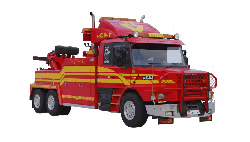
What to Do When Your Car Breaks Down on the Highway
What to Do When Your Car Breaks Down on the Highway
Last Tuesday, a driver called us from the A4 hard shoulder near Mysłowice. Her engine cut out at 130 km/h and she'd barely managed to coast to the edge. She was standing in the traffic lane because she didn't know what to do next. We see this more often than you'd think — and the wrong move on a motorway can be fatal.
Here's exactly what to do if your car stops on a Polish highway.
First Rule: Safety Above All
A breakdown on the motorway is nothing like one on a regular road. Vehicles pass at 120–140 km/h, which means even a brief stop in a traffic lane is life-threatening.
What to Do Step by Step
1. Turn On Your Hazard Lights Immediately
As soon as you feel something is wrong with your car, switch on your hazard lights. This signals to other drivers that you have a problem. Don't wait until the vehicle stops completely.
2. Pull Over to the Hard Shoulder
If possible, move to the hard shoulder (emergency lane) on the right side of the motorway. Try to get as far away from the traffic lane as possible. If you're near an exit or service area, try to reach a safe location.
Never stop in a traffic lane unless the vehicle completely refuses to move. In that situation, leave the hazard lights on and immediately exit the vehicle (on the side away from traffic).
3. Place a Warning Triangle
On a motorway, the warning triangle must be placed at least 100 metres behind your vehicle. This gives other drivers time to react.
Tip: When walking to place the triangle, walk on the outside of the crash barrier if possible. Never walk in a traffic lane.
4. Put On a Reflective Vest
A reflective vest is mandatory in Poland. It should be accessible in the passenger compartment (not the boot!). Put it on before leaving the car.
5. Exit the Vehicle and Stand Behind the Barrier
All passengers should exit from the right side (hard shoulder side) and stand behind the crash barrier. Don't stay in the car — if another vehicle strikes yours, it could be pushed into you.
How to Call for Help on the Motorway
SOS Emergency Phones
On Polish motorways, SOS call points are located every 2 km. Press the button to connect with the traffic management centre.
Phone Numbers
- 112 — emergency number (accidents with injuries)
- 981 — Roadside Assistance (in many regions)
- Motorway operator number — shown on information signs
- +48 571 426 225 — our direct line for fast assistance
Towing Rules on the Motorway
Towing on motorways is subject to special regulations:
No Rope Towing
On motorways and expressways, rope towing is prohibited. The vehicle must be transported on a flatbed or towed with a rigid tow bar.
Vehicle Removal Time
The motorway operator may require vehicle removal within a specified time. If you fail to do so, the vehicle may be towed at your expense by road services.
Motorway Towing Costs
Towing from a motorway costs more than from a regular road because of toll charges for the tow truck, the need for rapid response, and higher safety requirements.
The approximate cost of towing from a motorway is PLN 500–1,200 for a passenger car. Check our price list for details.
Most Common Causes of Highway Breakdowns
1. Flat Tyre
The most common cause of stopping on the motorway. At high speed, a tyre blowout is particularly dangerous.
2. Engine Overheating
Long driving at high speed on hot days can lead to engine overheating, especially with low coolant levels.
3. Running Out of Fuel
Surprisingly often, drivers forget to refuel before entering the motorway. Distances between petrol stations can be 50–80 km.
4. Battery Failure
An old or damaged battery can fail, especially after a long stop.
5. Electronics Problems
Modern cars have complex electronic systems that can malfunction and prevent further driving.
What NOT to Do During a Highway Breakdown
- DO NOT step into traffic lanes
- DO NOT attempt repairs while standing next to traffic
- DO NOT stay in the vehicle if it's in a traffic lane
- DO NOT reverse or make U-turns
- DO NOT cross the motorway to the other side
- DO NOT tow vehicles with a rope on the motorway
Key Takeaway
A highway breakdown requires quick, decisive action. Get yourself and your passengers safe behind the barrier, then call for professional help. Never try to fix the car yourself on the motorway — it's not worth the risk.
Stuck on the motorway right now? Call +48 571 426 225. Our flatbed drivers know the specifics of motorway towing and will reach you as quickly as possible. We operate 24/7 across Poland — Katowice, Krakow, and across Silesia.
Trenger du veihjelp?
Ring tauing: +48 571 426 225