Safe Winter Driving — Tips and What to Do in Case of Breakdown
Safe Winter Driving — Tips and What to Do in Case of Breakdown
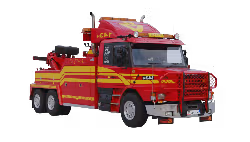
Every December we start getting the same calls: someone slid off the S86 near Katowice, or a car stalled on the A4 because the diesel gelled overnight. Winter in Poland causes 30–40% more accidents compared to summer, and we see the results first-hand from the cab of our flatbeds.
Here's what we've learned after 20+ years of winter call-outs — and how you can stay off our radar.
Preparing Your Car for Winter
Winter Tires
Poland has no legal requirement for winter tires, but they're essential for safety. Summer tires on snow have double the braking distance.
When to switch: When average temperature drops below 7°C (usually October/November). Don't wait for the first snow — winter tires perform better even at low temperatures without snow.
What to check: Tread depth minimum 4 mm, tires no older than 5 years, M+S or 3PMSF symbol, matching tires on each axle.
Winter Emergency Kit
Every driver should carry:
- Ice scraper and snow brush
- Winter washer fluid (to -20°C)
- Jump cables — dead battery is the #1 winter problem
- Thermal blanket
- Flashlight with spare batteries
- Folding shovel
- Sand or cat litter for traction
- Warm gloves and hat
- Water and energy bar
- Phone charger (power bank)
- Warning triangle and reflective vest
Winter Driving Techniques
General Rules
- Drive slower — reduce speed by 20–30%
- Increase following distance — 3x the normal gap
- Avoid sudden maneuvers — start smoothly, brake gently, turn softly
- Don't use cruise control on wet or icy surfaces
Starting on Snow/Ice
- Start in 2nd gear (manual) — less torque = less wheelspin
- If wheels slip, gently ease off the gas and try again
Winter Braking
- Brake earlier — stopping distance on snow is 3–5x longer
- ABS doesn't shorten stopping distance — it prevents wheel lock
- Before a curve, brake BEFORE the turn, not during
Skid Recovery
- Front-wheel skid: Release gas, steer in the direction of travel
- Rear-wheel skid: Steer into the skid, gently add gas (RWD) or release gas (FWD)
- Never brake hard during a skid
What to Do During a Winter Breakdown
A winter breakdown is more dangerous than in summer — low temperatures can cause hypothermia even at +5°C with wind chill. We towed a family of four off the A1 near Piotrków last January; the father had waited 40 minutes outside the car and was already shivering badly by the time we arrived.
Step 1: Secure the Scene
Turn on hazard lights, put on reflective vest, place warning triangle.
Step 2: Stay in the Car
Don't go out into the cold unnecessarily. Use the heater (crack a window to prevent CO poisoning). Use thermal blanket.
Step 3: Call for Help
Call +48 571 426 225. Give exact location, describe the problem and conditions.
Step 4: Wait Safely
Inform family, conserve phone battery, stay visible if you must leave the car.
Most Common Winter Breakdowns
- Dead battery (60% of winter calls) — cold reduces capacity by up to 50%
- Frozen diesel — regular diesel can gel below -15°C, use winter diesel
- Frozen locks and seals — prevention: silicone on door seals
- Fogged/frozen windows — use AC + windshield setting
- Stuck in snow — don't spin wheels, use sand/mats for traction
The Bottom Line
Safe winter driving comes down to preparation and common sense:
- Install winter tires before the first frost
- Pack a winter emergency kit
- Drive slower with more distance
- In case of breakdown — stay in the car and call for help
- Save our number: +48 571 426 225
Need winter assistance? We operate 24/7, even in the worst weather.
Vajate teeabi?
Kutsu puksiirteenus: +48 571 426 225